⛓️

Silent Mode

Domain names that live on the Bitcoin Cash blockchain. Websites with no host. No registrar, no DNS, no certificate authority — and three ways in, starting with one that needs nothing installed.

Open a .bch site now Downloads Host your own site

1 · The remote relay — no install at all

The fastest way in. A relay reads the blockchain for you and hands the page to your ordinary browser over ordinary HTTPS. Works on any phone, tablet or computer, in any browser, with nothing to download and no settings to change.

Open thisWhat you getWhere the page really lives
/bns/hello.bch A small pageinside a blockchain transaction
/bns/coinspectrum.deviant.bch A full multi-file siteSia storage network
/bns/faucet.deviant.bch A working appSia storage network
/bns/coinspectrum.bch The same site againan ordinary web server
/bns/argo.bch A small pageinside a blockchain transaction

How the relay does it

  1. You ask for a name. You open /bns/hello.bch. Your browser is just making a normal HTTPS request to this site — it never has to know that .bch exists, and no DNS lookup for it ever happens.
  2. The relay reads the blockchain. It connects to Bitcoin Cash nodes and searches the chain for that name's registration — the digital certificate that owns it — and reads the records attached to it. There is no registrar to ask and no database to query.
  3. It follows the record. A record says where the site lives: the page may be stored inside the transaction itself, on the Sia storage network, or on an ordinary server. The relay fetches it from wherever it is.
  4. It hands you the page. The content comes back over normal HTTPS, so it renders in any browser — including old phones and locked-down devices where you can't install anything.
What the relay costs you. Because it resolves names on your behalf, the relay operator can see which .bch sites you ask for. It keeps no logs — but that is a promise you have to trust, and one relay is also one thing that can be blocked. That is exactly why the other two options exist: install anything below and the lookup happens on your own machine, checked against the blockchain, trusting nobody.

2 · Install — resolve names yourself

Once something below is installed, your computer reads the blockchain directly. No relay in the middle, nobody to trust, nothing that can be blocked between you and the name.

alpha

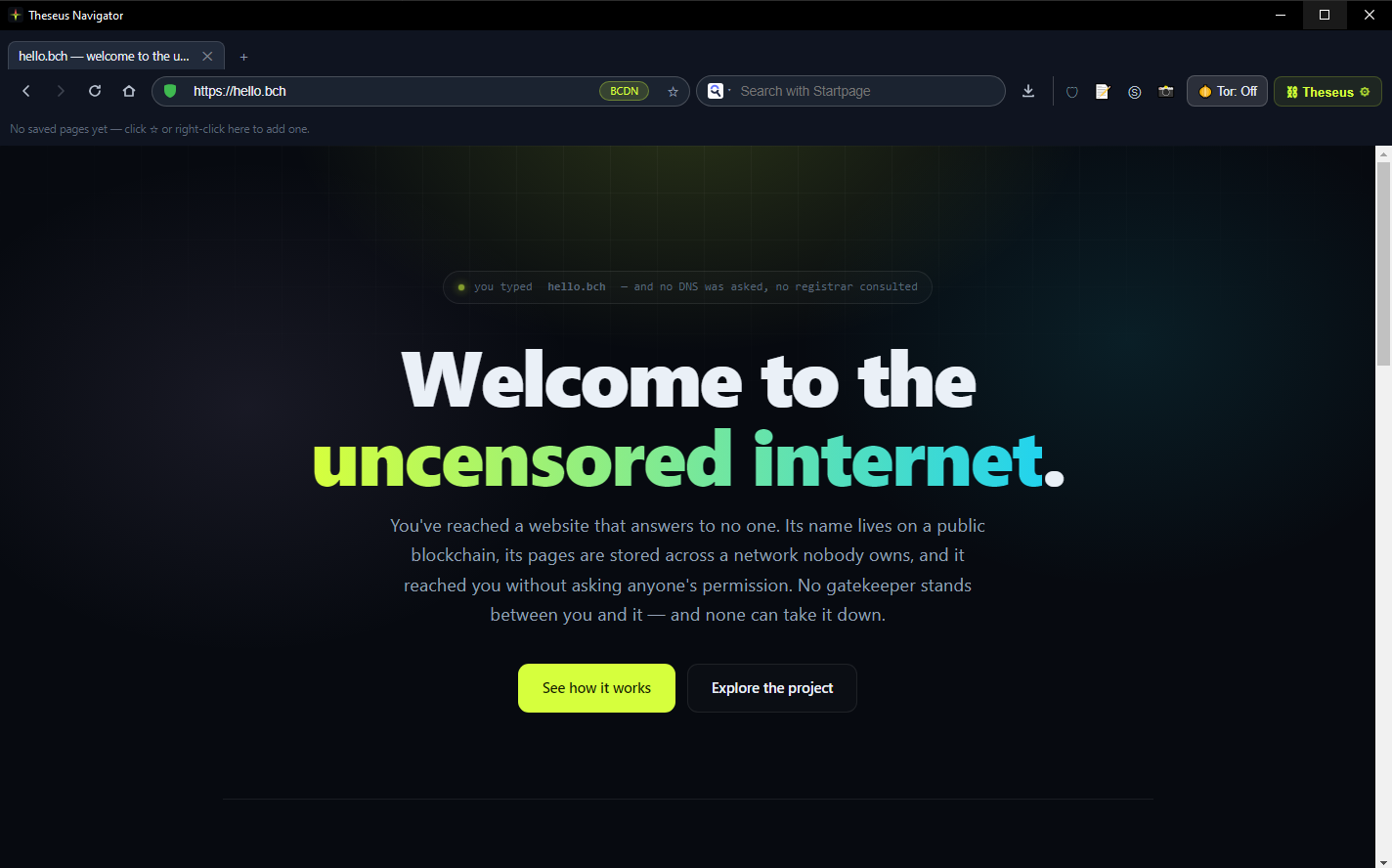
Theseus Navigator — the browser

A desktop browser that speaks .bch natively. Tabs, search, a home page, a one-click Tor switch, and a badge on every page showing whether it came from the chain, from Sia, or from a server. Changes nothing on your system.

Windows · ~90 MB · unsigned build (see “Verifying downloads”)
packaging in progress
alpha

Ariadne Resolver — system-wide

A small background service plus an installer. Teaches your whole computer to open .bch names — every browser, with HTTPS working. The most complete option; asks for administrator rights because it changes how your machine resolves names.

Windows · ~15 MB · installer + uninstaller
packaging in progress
alpha

Ariadne for Firefox — the extension

A browser add-on that resolves .bch names inside Firefox. 8 KB, no dependencies, no background service, no system changes. The lightest real install.

Firefox · 8 KB · also runs on Firefox for Android
packaging in progress
Verifying downloads. Every file published here will carry a SHA-256 fingerprint recorded on the Bitcoin Cash blockchain. You will be able to check what you downloaded against the chain itself — not against this website, not against a mirror, not against us. Builds are deliberately unsigned: a code-signing certificate requires a legal identity, and needing one is precisely what this project exists to avoid. Your operating system will warn you about an unrecognized app; that warning is expected, and the fingerprint is the real check.

3 · Publish your own site

A name costs a fraction of a cent and needs nobody's approval. Storage on the Sia network costs a few dollars per terabyte per month — for a normal website, effectively nothing.

Register a name

Registering writes a digital certificate to the Bitcoin Cash chain. Whoever holds that certificate owns the name — permanently, and without any registrar who could take it back.

Put the files somewhere

Small pages fit inside the blockchain transaction itself. Larger sites go on the Sia network, where they are encrypted, split into pieces, and spread across independent storage providers worldwide. Or point the name at any server you already run.

Point the name at it

Attach a record saying where the content lives. Updating it later is a signed transaction only the certificate holder can make — so nobody else can redirect your name.

What Sia hosting means in practice. Your site is encrypted on your machine before it leaves, cut into ~30 pieces, and scattered across independent hosts — any 10 of which can rebuild it. No single host holds your site, none of them can read it, and several can vanish without it going down. There is no hosting company to bill you, suspend you, or receive a takedown notice.

Why this exists

Every layer of the web has a gatekeeper. Names are rented from registrars under a single root. Identity is vouched for by a handful of certificate authorities. Software reaches people through app stores. Each of these can be pressured, and each of them has been.

None of them are technically necessary. This is a working demonstration of what is left when you remove them — built in the open, verifiable against a public chain, by people you do not have to know or trust.